Change Language :
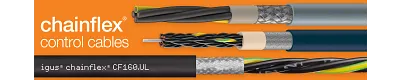
Control cables from chainflex® with low bend radii for high speeds
Built for extreme environments and tested for millions of cycles
Control cables are the workhorses of motion applications, carrying power and control signals to motors, drives, and actuators as a machine moves. Standard, stationary-rated cable cracks and fails when it is asked to flex and twist inside a cable carrier over millions of cycles — a failure mode that causes unplanned downtime and costly line stoppages. chainflex® solves this with stranding and jacket constructions engineered specifically for continuous repeated motion, available as unshielded or shielded control cables with a choice of PVC, PUR, and TPE outer jackets, holding up under high speeds, low bend radii, and extreme temperatures where standard cable was never designed to perform. As automation lines demand faster cycle times and tighter cable carrier geometries, more engineers are specifying flexible control cable from the start, rather than replacing standard cable after it fails.
Browse chainflex® control cables



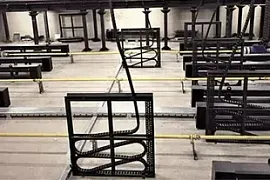
chainflex® Application Stories


Browse the Engineer's Toolbox
Frequently Asked Questions About Continuous Flex Cables
chainflex® cables are industrial-grade continuous flex motion cables designed for dynamic applications such as robotics, automation, and machinery. They are tested for millions of cycles and engineered to prevent cable failure in demanding environments.
Standard cables often fail under constant motion, leading to downtime and costly replacements. chainflex® continuous flex cables are designed with special materials and optimized stranding to withstand up to 2 billion test cycles, ensuring long service life and reliable signal transmission.
Usually not. On most spec sheets "flexible" means flexible enough to route during installation, which is a different requirement from surviving millions of bend cycles. Inside a carrier, layer-stranded cable built for installation flexibility fails through conductor breaks, corkscrewing, and jacket cracking. The chainflex® classification separates the two: classes 1 and 2 are flexible and highly flexible cables, while class 3 and above are built for use inside e-chain® cable carriers.
chainflex® cables come with a UL-verified guarantee of up to 4-year service life. This guarantee is based on testing in the world’s largest cable test lab of its kind, where cables undergo up to 2 billion cycles annually.
chainflex® continuous flex cables meet global standards including UL, CE, EAC, NFPA 79, and cleanroom ISO Class 1. They also support major communication protocols such as PROFINET, PROFIBUS, EtherCAT, and CC-Link.
By using specialized designs for continuous flexing, chainflex® cables minimize insulation cracks, conductor breaks, and EMI issues. This means fewer cable failures, less machine downtime, and higher production efficiency.
It is a four-digit rating for basic requirements, travel distance, oil resistance, and torsion, in that order. Basic requirements run 1 to 7, travel 1 to 6, oil resistance 1 to 4, and torsion 1 to 4, so the range spans class 1.1.1.1 up to class 7.6.4.4. A light-duty shielded PVC control cable like CF881 is class 3.1.1.1; a maximum-duty TPE cable like CF9 is class 7.6.4.2. Reading the code tells you at a glance whether a control cable matches your travel, chemical exposure, and motion type.
The chainflex CASE system reduces packaging waste, improves cable handling, lowers shipping costs by up to 84%, and allows easy reordering—supporting cost savings and greener logistics.
Yes. Depending on the cable type, they are available with oil-resistant, UV-stable, flame-retardant, and halogen-free materials, making them suitable for harsh industrial environments.
igus® provides free online tools including a service life calculator and cable configurator. These help you select the right cable and predict its performance in your specific application.
Yes. Engineers and purchasing managers can request a free cable sample box to evaluate product performance before committing to larger orders.
Choose shielded control cables when lines run near motor controllers, servo controllers, or other switching noise sources, or when the signals themselves are sensitive enough that induced noise causes false readings. Choose unshielded when there is no interference concern and cost and outer diameter matter more. Many chainflex® control cables come as matched pairs for exactly this decision — CF880 unshielded and CF881 shielded share the same PVC jacket, temperature range, and bend rating, with a braided shield as the only difference.
Yes. The readycable® service supplies chainflex® control cable pre-harnessed with connectors and ready to install, including versions built to match the connector standards of major controller manufacturers. Pre-harnessed cable removes shop-floor assembly time and the wiring errors that come with it, and can be delivered already installed inside a readychain® cable carrier system.
Yes. Control cables are sold as bulk cable by the foot or meter with no minimum order quantity, so you can order the exact length a machine build needs instead of a full reel. Cut lengths ship on the chainflex® CASE packaging system when applicable, which reduces packaging waste and makes reordering straightforward.
Contact Us
Questions or product information? Please contact:

Customer Service
Customer Service:
Phone: Monday to Friday from 8 am - 5 pm
LiveChat: 24 hours
Book a Call
Book an Appointment with a Product Expert