Change Language :
EC.PR position-dependent push/pull force measurement
Protect the entire length of travels of up to 1,000m
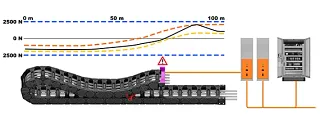
Avoid system-dependent imprecision for push/pull force monitoring systems on travels longer than 150 m. System-dependent imprecision due to static force limits for travels > 150m are a thing of the past. Now there is the new EC. PR module. Here, force limits are dynamically adjusted with information from PLC control systems, OPC-UA servers, or analogue (4-20 mA) path measurement systems (Profinet /EC. PP). This reduces repair cost and effort; replacing a stacker reclaimer, for example, costs $30,000 or more.

Tech up
- Position-dependent reduction of maximum push/pull force limits at which the system is shut down – freely
defined for each point along the travel. - Position information via additional modules from Siemens PLC, OPC-UA servers, or analogue or digital path measurement systems.

Cost down
- Avoid unplanned repair costs such as $49,798 or more for replacing a stacker reclaimer.
- Integration into existing control concepts and switch cabinets
- Standard strain gauge sensors and load cells can be used in igus® floating moving ends

Proof
- Tested on a 200-m field test stand in the world's largest laboratory for dynamic energy transmission systems
- Video 1 of the igus® test stand
- Video 2 of the igus® test stand

Sustainability
- For example, save 32kg of CO² emissions for each repair deployment avoided. 2
- Less raw material required thanks to the option of partial repair instead of complete replacement.
- More about the igus® contribution to Plastic2Oil

Potential application areas
We have developed iglidur EC.PR for this purpose
- Long travels > 150m in project business
- Stacker - reclaimer
- Automatic cranes
Sample can be delivered within 14 days for BETA TEST projects. Delivery time for BETA test projects: 14 days
You might also be interested in
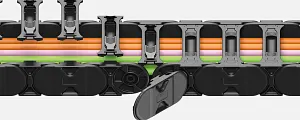

1* igus® application at Tata Steel in Haldia, India with a travel of 480m and a chain length of 240m was able to avoid a replacement worth about $30,000
2* Randomly chosen Mercedes vehicle built in 2015 with 160 grammes of CO²/km at a randomly defined 100-km departure/arrival