Change Language :

Cable Festoon System vs. Cable Carrier
igus® alternative to a cable festoon system
Cable festoon systems are a common energy supply solution in overhead cranes and mobile heavy-duty machinery. Yet in these systems cables hang free and loose, exposed to the wind and weather. Unprotected, they can swing freely and become tangled, leading to costly maintenance efforts and unplanned downtime. Festoons also require regular relubrication of cable trolleys, and additional motor and control systems are needed for long travel applications.
igus offers a secure and modular alternative that allows you to protect cables and avoid downtime: e-chain® cable carriers. Cables sit within the e-chains, securely managed and protected from environmental effects. They are ideal for use in the oil and gas and shore power industries, as well as various crane applications such as bulk handling cranes, ASC cranes, STS cranes, RTG/RMG cranes, and indoor cranes.
White Paper: Efficient energy supply systems for cranes in steel plants
Festoons are the primary solution for cable management in indoor cranes in steel plants. Read this white paper to learn about the potential of e-chain® cable carriers as an alternative to festoons for these applications, and the recent innovations propelling e-chain technology forward.

Case Study: of a cable festoon system at a 100m plant
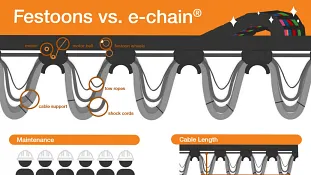
Infographic: Cable festoon systems vs. e-chains®
Festoons have been a staple in crane operations for decades, but e-chain cable carriers present a more reliable, low-maintenance alternative. View this infographic for a detailed comparison between the two types of systems.
Alternatives to cable festoons


Festoon replacement applications


Frequently Asked Questions
Traditional cable festoon systems can be prone to tangling during operation, leading to downtime. They also require huge lengths of cable, taking up a great deal of space and needing protective cladding, which increases the mechanical stress on the cables
Festoons consume space on the crane rail, limiting the amount of crane travel that can be accomplished, and the structure makes cable replacement or addition a time-consuming process.
Unprotected cables in festoon systems can swing, become tangled, and get caught in the crane structure, especially during harsh weather, leading to costly repairs and downtime.
Cable festoon systems require approximately 115% of the travel length in cable, while energy chain systems require about 50% less cable, reducing mechanical stress and system weight.
Cable festoons have to be specially protected in harsh environments, increasing the total weight of the system and the steel structures required to bear the large cable lengths and the cable junction.
Cable carriers can lead to lower operational costs and increased energy savings due to their energy-efficient design and reduced maintenance requirements. In contrast, cable festoon systems have limits with regard to energy efficiency and service life, requiring higher energy input and maintenance costs.
The low wear properties of cable carriers ensure a high service life and minimize maintenance requirements and downtime, while cable festoon systems have suboptimal wear behavior, increasing the need for maintenance and potentially causing system downtime in the long term.
Cable carriers, made from tribologically optimized polymers, ensure a high service life and minimize maintenance requirements and downtime, providing a durable and low-cost solution for industrial crane systems. In contrast, festoon systems have proven to have limits with regard to energy efficiency and service life, requiring extensive protective cladding and being relatively heavy.
More crane technology information


Discuss your project with an expert!
Whether you're interested in end-to-end, fully assembled solutions or looking to build your own customizable project, let us assist you with a solution based on your specific application and requirements. Contact us via the form below or call us at (800) 521-2747 to discuss your project today!
Contact Us
Questions or product information? Please contact:

Customer Service
Customer Service:
Phone: Monday to Friday from 8 am - 5 pm
LiveChat: 24 hours
Book a Call
Book an Appointment with a Product Expert